Social Media Audit Sample + Free Template: What to Fix Next

You sit down to plan next week's posts. Instagram shows more views. TikTok shows more comments. The shop shows roughly the same sales. Your spreadsheet has more colours than a bag of sweets.
Then someone asks, “So, what should we make next?” You open another tab. Your coffee is doing more work than the action plan.
This social media audit sample shows how to turn those numbers into decisions. Copy the workbook, follow the completed example and choose one useful change.
Quick answer: A social media audit reviews your accounts, content, audience signals and business results to identify what works, what needs fixing and what to create next. Compare consistent periods and similar objectives, then give each finding a specific action and a review plan.
Completed social media audit sample
Brand and audit context
Every figure below is illustrative. The bottle brand is invented. Sadly, so are the sales.
| Audit detail | Completed example |
|---|---|
| Business | Reusable bottle brand |
| Goal | Grow tagged website visits from 800 to 1,000 by September 30 |
| Period | September 1–30, 2026, compared with August 2–31 |
| Platforms | Paid Meta Reels, organic Instagram and TikTok |
| Posts reviewed | Six |
| Main metric | Tagged website sessions, called visits below |
| Orders | Purchases completed in those sessions; no view-through credit |
Channel-level audit
| Channel | Posts | Impressions | Visits | Orders | Next step |
|---|---|---|---|---|---|
| Meta Reels, paid | 3 | 60,000 | 820 | 33 | Retest the demo; repair or pause weaker edits |
| Instagram, organic | 2 | 21,000 | 85 | 5 | Repeat useful teaching; answer buying questions |
| TikTok, organic | 1 | 16,000 | 100 | 4 | Collect more comparable evidence |
The reviewed posts generated 1,005 tagged visits, above the 1,000 target. This describes progress; it does not establish what caused it.

Post-level creative audit
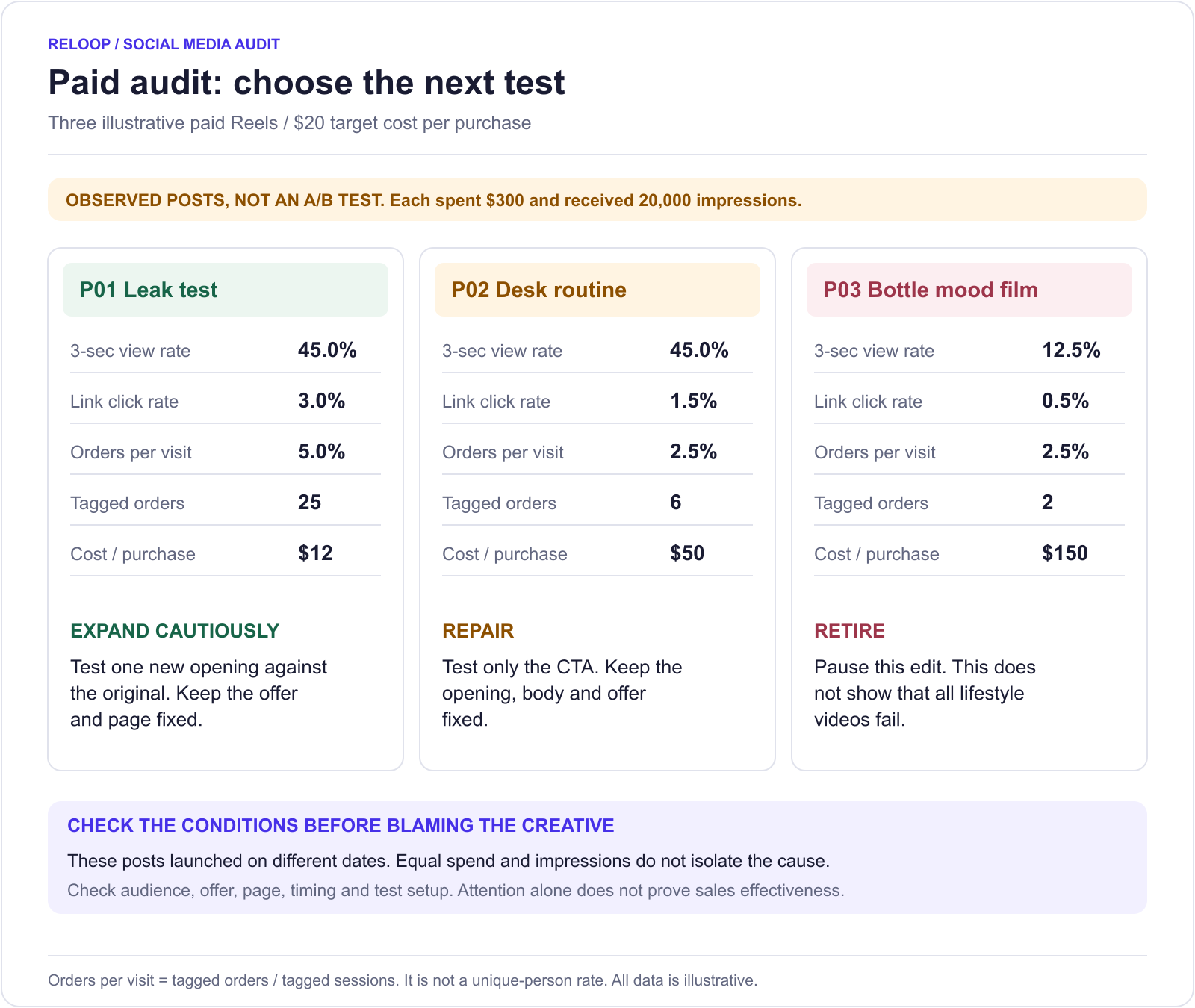
Each paid ad spent $300 and received 20,000 impressions. Their launch dates differed, so this is an observational comparison.
| Post / format | Hook | Angle | Proof | CTA | Observed result | Decision |
|---|---|---|---|---|---|---|
| P01: demo | “Will your bag stay dry?” | Avoid leaks | Bottle inversion test | Shop the bottle | 25 orders; $12 each | Expand cautiously |
| P02: routine | “Your desk needs a water break” | Convenience | Lifestyle footage | Learn more | 6 orders; $50 each | Test a clearer CTA |
| P03: montage | “A better kind of everyday” | Aspiration | Beauty shots | Shop the bottle | 2 orders; $150 each | Pause this edit |
The prettiest ad does not get a participation medal.

Findings from the sample
- Paid candidate: The leak-test demonstration deserves another controlled test.
- Promising topic: Cleaning instructions earned 420 saves.
- Opening signal: P01 and P02 tied at a 45% three-second view rate.
- Proof to investigate: Visible product testing accompanied the cheapest observed purchases.
- Purchase problem: P02 earned attention but costly orders.
- Content gap: Eight of P06's 18 comments asked about cup-holder fit.
- Next test: Answer that fit question with a clear demonstration.
These are hypotheses, not isolated explanations of performance.
Copyable social media audit template
The workbook contains blank audit and post sheets, plus completed examples. Fill the fields relevant to your goal. Your keyboard does not need an endurance test.
Account and channel fields
| Field | Your entry |
|---|---|
| Platform, handle and URL | [Account] |
| Owner and publishing frequency | [Person; posts per period] |
| Business objective and conversion action | [Goal; purchase, signup or enquiry] |
| Intended audience and audience evidence | [Buyer; observed fit] |
| Profile consistency and working links | [Checks; fixes needed] |
| Baseline, target, deadline and comparison period | [Starting value; goal; dates] |
Content and creative fields
| Field | Your entry |
|---|---|
| Post URL, date and paid/organic status | [Reference; date; distribution] |
| Format, topic and opening hook | [Execution; subject; first line or visual] |
| Angle, proof and product visibility | [Promise; evidence; when product appears] |
| Offer, CTA and destination | [Deal; next action; landing page] |
Performance fields
| Field | Your entry |
|---|---|
| Reach or impressions | [Value; exact definition] |
| Watch time or completion | [Value; video length] |
| Saves, shares and comments | [Counts; useful comment themes] |
| Clicks, visits and conversions | [Values; source; attribution window] |
| Spend and purchase cost, when relevant | [Spend; cost per tracked purchase] |
| Finding, evidence and other explanations | [Observation; support; limitations] |
| Action, owner and review plan | [Change; person; when to check] |
| Follow-up result and next decision | [What happened; next step] |

What is a social media audit?
A social media audit examines your existing accounts, audience, content and results. It produces findings and priorities. Your  social media strategy uses those findings to plan future work.
An audit without a next step is a spreadsheet having a nice lie-down.
Michigan Technological University's audit guidance follows this broader scope: goals, accounts, content, audience, branding, competitors and action.
What should a social media audit include?
Account health
Check ownership, bios, product links, branding and inactive profiles. A broken shop link is a door painted on a wall.
Business goals
Choose one main outcome with a baseline, target and deadline. AMEC's Barcelona Principles support measurable objectives and both qualitative and quantitative evaluation.
Audience alignment
Review buyer locations, questions and behaviour where available. Your mum liking every post is lovely. It is not a customer segment.
Content performance
Compare results against each post's intended job. Likes still refuse to pay postage.
Creative patterns
Tag recurring hooks, topics, formats, proof and CTAs. Look for patterns across several comparable posts.
Conversion performance
Check clicks, visits, purchases, leads or signups. Record how each system credits the action.
Competitor and market context
Look for repeated approaches and unanswered needs. Copying everyone gives the internet more twins.
Production bottlenecks
Record missing assets, approval delays and time spent. Five people approving a caption is a very small traffic jam.
How to conduct a social media audit in seven steps
1. Choose one objective and a consistent period
Use a period with enough relevant activity, perhaps 60–90 days. Compare equivalent windows and label launches, offers or seasonal changes. The sample uses two 30-day periods for simplicity.
2. Inventory active and abandoned accounts
List handles, owners, account roles, branding and destination links. Include forgotten profiles that customers can still find.
3. Export comparable platform and business metrics
Record the source, export date and measurement window. Let the export button do the counting. Your fingers have other plans.
Use consistent campaign tags. Google's UTM guidance explains source, medium and campaign parameters; utm_content can distinguish creative versions.
4. Identify the strongest and weakest posts
Group by objective, format and distribution before comparing. A meme with 1,000 likes has not automatically sold 1,000 bottles. The bottles would like to confirm that.
5. Tag the creative variables
Record format, hook, angle, proof, product visibility, offer and CTA. For paid comparisons, also note audience, placement, destination and test setup.
6. Audit competitors and market patterns
Use our  competitor ad analysis guide to identify recurring messages and gaps. An active ad's age alone does not prove profitability.
7. Convert every finding into a decision
Choose scale, repair, retire, explore or hold for more data. Assign an owner and review point. The goal is a useful decision, not a bigger spreadsheet. The spreadsheet is big enough.
The scale, repair, retire or explore framework
This is Reloop's practical decision framework, informed by measurement principles. It has not been independently validated as a predictive model.
First check the evidence. Mixed objectives, missing data or an unfair comparison call for hold for more data.
| Signal | Possible reading | Decision | Next action |
|---|---|---|---|
| Repeated, comparable results meet the business goal | Promising concept | Scale | Expand gradually and check again |
| Attention looks healthy; purchases are costly | A later stage may need work | Repair | Test one suspected weakness |
| Current edit remains weak after a fair review | Poor use of the current budget | Retire | Pause that version and record the lesson |
| Comments reveal an unanswered buying question | New content opportunity | Explore | Create an honest demonstration |
| Too little comparable evidence | Conclusion is premature | Hold | Collect better evidence |
One good post does not need a crown. Mark it as a retest candidate first.

How to audit creative performance properly
Compare like with like
Match objective, platform, format and post age. Flag different audiences, offers or delivery conditions.
Separate organic and paid distribution
Paid reach changes the comparison. Record boosted posts separately and note when promotion started.
Distinguish attention from conversion
IAB/MRC's attention guidelines treat attention as useful alongside outcome measures. A strong opening does not establish sales effectiveness.
Look for repeated patterns, not one lucky post
Repeat the comparison before judging a whole format or channel. A viral cat can become famous while your bottles remain unemployed.
Record what remained constant
Separate what you observed from what you tested. NIST's experimental-design guidance explains why randomization, replication and confounding matter when drawing causal conclusions.
For the organic sample, compare tutorials at 14 days old. The illustrative save ratio is 420/12,000 impressions, or 3.5%, versus a previous 200/10,000, or 2.0%. That suggests a useful topic to repeat, without proving sales lift.

Which social media audit metrics matter?
| Objective | Useful signals | Business check | Limitation |
|---|---|---|---|
| Awareness | Relevant reach, video views | Brand searches or visits | Exposure does not prove recall |
| Engagement | Saves, shares, useful replies | Return visits or enquiries | Interaction does not prove purchase intent |
| Traffic | Link clicks, tagged sessions | Relevant destination visits | Clicks do not guarantee good visitors |
| Conversion | Orders, leads, signups, cost per action | Revenue or qualified leads | Attribution does not establish incremental lift |
Keep definitions visible. IAB's video-impression report documents differences between platforms.
The workbook's orders per session ratio divides orders by tagged visits. It is not a unique-person conversion rate. Its paid purchase cost uses media spend, so it also excludes production costs.
Social media audit tools: what do you actually need?
| Method | Useful for | Main limitation |
|---|---|---|
| Native analytics | Platform metrics and audience information | Separate exports and definitions |
| Spreadsheet | Tagging posts and recording decisions | Manual upkeep |
| Social management software | Reporting, scheduling and asset organization | Reports still need interpretation |
| Research and creation workflow | Turning findings into content variations | Requires reliable inputs and review |
A spreadsheet is fine. It just will not fill itself out of guilt. Compare  AI tools for social content creation when making the next assets becomes the bottleneck.
Common social media audit mistakes
- Comparing posts with different goals.
- Treating likes as revenue.
- Mixing organic and paid delivery.
- Combining different attribution windows.
- Changing several variables and claiming one caused the result.
- Copying competitors without a customer reason.
- Recording findings without an owner or follow-up.
A dashboard with 40 charts is not 40 times more helpful.
What should you do after the audit?
Pick three clear findings, turn each into a hypothesis and choose one change to test. Record the result before deciding what follows.
Keegan and Rowley's research connects social-media evaluation to management decisions. Our  creative testing framework explains the next testing stage.
Test one thing. Your video does not need a new personality every Tuesday.

Turn your audit findings into new social content
Reloop offers a free brand audit to help you review your brand mentions, view counts, calls to action and share of voice within your tracked category.
Use the report's brands, platforms and time period to understand the comparison. This measures observed social visibility; revenue market share requires separate sales data.
Then use Reloop's market intelligence to research hooks and formats, create social content or ads, organize assets and schedule posts to TikTok and Instagram. Start with one finding, such as the cup-holder question, and make the next useful piece of content. Our  TikTok video ideas can help with the execution.
Fewer tabs. Your laptop can stop making airplane noises.